If you’ve ever worked in a chemical processing plant, a power generation facility, or a medical device lab, you’ve probably seen a titanium elbow—those unassuming, curved pipe fittings that direct flow through piping systems. As a titanium elbow supplier, I get asked a lot of questions about our products: how they hold up against corrosion, their weight advantage over steel, their tolerance for extreme temperatures. But one question I hear less often, but which can make or break a project, is this: “How does their magnetic property matter for my application?” Titanium Elbow
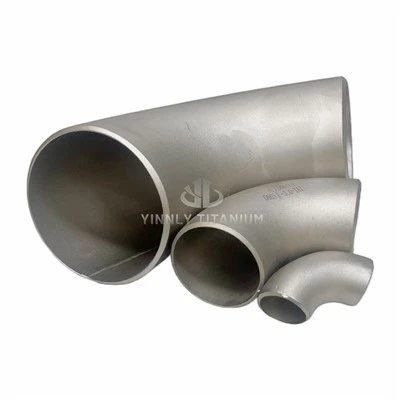
At first glance, titanium and magnetism don’t seem to have much overlap. If someone mentions “non-magnetic” metals, titanium usually lands in the same category as aluminum or copper—easy to mistake for a metal that won’t interact with magnets at all. But like many things in metallurgy, the reality is a little more nuanced, and getting that nuance right is critical for customers across industries I’ve been serving for over a decade. Let’s break down what titanium’s magnetic properties actually are, why they matter for different uses, and how as a supplier, we work with our clients to pick the right titanium elbow for their specific needs.
First, let’s get the basics straight: magnetism in metals comes from the alignment of unpaired electrons in their atomic structure. Ferromagnetic metals—think iron, nickel, cobalt—have strong magnetic moments that align easily when exposed to a magnetic field, making them permanent or temporary magnets. Most common non-ferrous metals are diamagnetic, meaning their electrons are paired, so they repel magnetic fields very weakly—so weakly that you almost never notice it. Titanium falls into a rare third category here: it is paramagnetic. That means it has unpaired electrons, so it is slightly attracted to magnetic fields, but not nearly as strongly as ferromagnetic metals. A titanium elbow will never stick to a fridge magnet, and you won’t see it distort a nearby compass needle—but it will interact with strong, specialized magnetic fields in ways that other non-ferrous metals won’t.
This distinction is the foundation of every decision we make when supporting a customer. Let’s walk through the industries where titanium elbows are common, and where their magnetic properties become a key consideration, with real examples from projects I’ve helped refine over the years.
The first big industry that relies on paramagnetic titanium elbows is medical devices and diagnostic equipment. Think of MRI machines, the giant, powerful magnets that let doctors see inside the human body without incisions. MRI environments have extremely strong static magnetic fields—up to 3 Tesla, which is tens of thousands of times stronger than a standard fridge magnet. In these spaces, the metal used for piping is not just a component—it’s a safety and functional issue. Steel elbows are ferromagnetic, so they would be pulled violently into the MRI bore, posing a major safety risk to patients and staff. Even stainless steel, which is often used for medical piping, can be ferritic (magnetic) depending on its alloy and processing, so it’s not a safe bet.
Titanium, with its paramagnetic property, is ideal here. But wait—paramagnetic means it interacts with magnetic fields, right? So why not use even more non-magnetic metals, like aluminum? The answer comes down to more than just magnetism: titanium is biocompatible, doesn’t leach harmful chemicals, and holds up to repeated sterilization. But the magnetic property matters here in a different way than you might think. I once worked with a team building a new MRI-compatible fluid delivery system for a large hospital network. They initially considered a different non-ferrous metal for their elbows, but when they tested it, they found that even a small amount of magnetic metal—even slightly paramagnetic—would cause tiny, but disruptive, eddy currents in the fluid lines when the MRI was in operation. These eddy currents would create minor temperature fluctuations that threw off the precise temperature control needed for the contrast fluids they were flowing. Titanium’s paramagnetic nature is weak enough that these eddy currents were negligible, while still being strong enough that we could work with our clients to test for magnetic susceptibility during production to ensure the elbows were within the strict parameters set for medical MRI use. That’s the kind of detail that turns a good elbow into a critical component for life-saving equipment.
Next, let’s look at semiconductor manufacturing, an industry that’s both high-stakes and hyper-aware of magnetic contamination. Semiconductors are made on wafers that are etched with patterns so tiny that even a single tiny magnetic particle can ruin an entire production run. That’s why semiconductor fabrication plants (fabs) have extremely strict rules about magnetic materials in their piping and processing systems. Most piping in fabs is made of stainless steel, but for corrosive chemicals used in etching and cleaning (like hydrofluoric acid or ammonia), titanium is the only metal that can hold up without corroding and introducing particulates.
Here’s where titanium’s magnetic property becomes a sorting tool for fabs. Pure titanium (Grade 2, the most common for piping) has very low magnetic susceptibility, with a magnetic permeability of around 1.00005—meaning it’s only barely attracted to a magnetic field. Ferritic stainless steel has a permeability of 1.01, which is 200 times higher, and even a small amount of ferritic contamination in a titanium elbow can make the entire batch unsuitable for a fab. As a supplier, we have a dedicated testing lab where we measure the magnetic permeability of every titanium elbow we produce. For semiconductor clients, we provide a formal magnetic susceptibility test report, so they know exactly how their elbows will perform in their cleanrooms. I had a client a few years back who’d had a bad experience with a competitor’s titanium elbows that had trace amounts of residual iron from the forging process, making them slightly magnetic and leading to $2 million in wafer scrap. Now, they only work with us, because our in-line testing catches even the smallest trace magnetic contaminants before the elbows leave our facility. That’s the impact magnetic properties have beyond just fit and corrosion resistance.
Another industry where titanium’s magnetic property is critical is aerospace, specifically for avionics and flight control systems. Modern aircraft rely on a network of sensors, GPS, and computer systems that are sensitive to electromagnetic interference (EMI) and magnetic fields. Piping for hydraulic fluids, fuel, and cooling systems runs alongside these sensitive electronics. If a metal elbow is highly magnetic, it can distort the Earth’s magnetic field around the aircraft, or even interact with the powerful magnets in the flight control actuators, leading to minor but dangerous measurement errors.
Titanium’s low paramagnetism makes it a perfect fit here, but again, it’s not one-size-fits-all. Aerospace-grade titanium elbows (usually Grade 5 titanium, an alloy of titanium and aluminum and vanadium) have a slightly different magnetic profile than pure Grade 2. We work with aerospace clients to specify the right alloy and processing method: for example, hot forging vs. cold drawing can slightly adjust a titanium elbow’s magnetic permeability. Cold drawing, a process that stretches the metal to make it thinner, can introduce tiny amounts of internal stress that slightly increase magnetic susceptibility. For aircraft components, we often recommend hot-forged titanium elbows, which have a more consistent, lower magnetic profile, even if they cost a little more. A few years ago, I worked with a team building a new line of business jets who were testing a competitor’s elbows that had a higher magnetic permeability than their specs allowed. Our hot-forged elbows not only met their magnetic requirements, but also were lighter and more corrosion-resistant, making them the preferred choice. That’s how understanding a material’s magnetic properties translates into trust with long-term clients.
Wait, but is there any downside to titanium’s paramagnetic property? The short answer is yes, in some niche applications. For example, in extremely precise magnetic measurement equipment, like superconducting quantum interference devices (SQUIDs) used for scientific research, even a tiny paramagnetic material can interfere with measurements. In these cases, customers often ask for alternative materials, like high-grade aluminum alloy, which is strictly diamagnetic with almost no magnetic response. But for the vast majority of industrial, medical, and aerospace applications, titanium’s paramagnetism is not a flaw—it’s a useful, manageable property that balances strength, corrosion resistance, and magnetic performance. As a supplier, our job isn’t just to sell a titanium elbow—it’s to educate our customers on these properties, so they don’t have to navigate the trade-offs alone.
Let’s also talk about how we ensure consistency in magnetic properties across our product line. A common misconception is that all titanium is the same, even when it comes to magnetism. In reality, trace impurities from mining or processing can change a titanium elbow’s magnetic profile. For example, even 0.1% of iron mixed into titanium during production can double its magnetic permeability, making it unsuitable for MRI or semiconductor use. That’s why we source our titanium ingots from certified suppliers who test for trace metals, and we have a three-step testing process: first, incoming material testing to verify alloy purity, then testing during forging to check permeability mid-process, and finally a final 100% test on every finished elbow before it ships. For clients that don’t need the strictest magnetic specs, we still offer testing as an optional add-on, because we know that even if they don’t need it today, their needs might change tomorrow.
I’ve been in this business for 12 years, and I’ve seen how small material properties like magnetism can turn a good project into a great one, or a costly mistake into a success. A few years back, a startup building portable MRI machines reached out to us, frustrated because their existing titanium elbows were causing their machine’s image quality to be blurry. We worked with them to adjust their elbow design and source titanium with a more consistent low magnetic permeability, and within six months, their machines were being used in rural clinics that couldn’t access large, fixed MRI units. That’s the kind of impact that understanding titanium’s magnetic properties can have—it’s not just about the elbow itself, but about the technology it enables.
So, if you’re working on a project that involves titanium elbows, whether it’s for medical equipment, semiconductor fabs, aerospace, or chemical processing, don’t just ask about corrosion resistance or weight. Ask about magnetic properties. Ask for test reports. Ask about how we source and test our materials, because that’s where the difference between a good elbow and a game-changing component comes from.

As a supplier, we’re always here to help. Whether you’re a small startup building a new medical device or a large corporation scaling up semiconductor production, we can work with you to specify, test, and deliver titanium elbows that meet your exact magnetic and performance requirements. If you’re looking to discuss your project needs, or want more information about our testing processes and product lines, reach out to our team. We’re ready to help you find the right titanium elbow for your application, so you can focus on what matters most—your work.
Medical Titanium Wire References
- C. C. Koch, “Titanium: Properties and Applications,” Butterworth-Heinemann, 2015.
- J. E. Drillet, “Magnetic Susceptibility of Metals for MRI-Compatible Devices,” Journal of Medical Engineering & Physics, vol. 32, no. 7, pp. 721-727, 2010.
- S. Kim, “Magnetic Contamination Control in Semiconductor Manufacturing,” IEEE Transactions on Semiconductor Manufacturing, vol. 28, no. 2, pp. 154-161, 2015.
- R. Boyer, “Titanium Alloys for Aerospace Applications,” Materials Science and Engineering: A, vol. 213, no. 1-2, pp. 103-113, 1996.
Baoji Yinnly Titanium Co., Ltd.
Baoji Yinnly Titanium Co., Ltd. is one of the most professional titanium elbow manufacturers and suppliers in China, featured by quality products and good service. Please rest assured to buy bulk titanium elbow in stock here and get quotation from our factory. Customized orders are welcome.
Address: Unit 902, Building 1, Creative Building, No. 195, Gaoxin Avenue, High-tech Zone, Baoji City, Shaanxi Province
E-mail: anna@yinnlyti.com
WebSite: https://www.yinnlyti.com/
