When I first started as a leaf spring supplier for FAW, back in 2012 when I joined the family business we’d built up over three decades prior, most of our orders were for FAW’s heavy-duty diesel trucks. Every spring, we’d run three shifts just to keep up with demand for leaf springs that could handle the rough roads of northern China, hauling construction materials and agricultural goods. These springs were forged from high-grade 60Si2Mn steel, heat-treated to a Rockwell hardness of HRC 42-45, and tested to withstand 120% of the vehicle’s maximum rated load—we knew every curve and thickness by heart, because our name was stamped into every spring we shipped to FAW’s assembly lines in Changchun. But in 2018, FAW began shifting its focus to electric vehicles (EVs), and suddenly, the questions started. “Can your leaf springs for FAW work on our new electric trucks?” FAW’s engineering team would call, and I’d pause, because for years, leaf springs were a diesel-only component in most people’s minds. I spent the next five years digging into EV suspension dynamics, testing our existing springs, and working side-by-side with FAW’s R&D to figure out if our proven FAW leaf springs could make the transition. It turns out, the answer isn’t a simple yes or no—but it’s a lot closer than most people assume. Leaf Spring for FAW
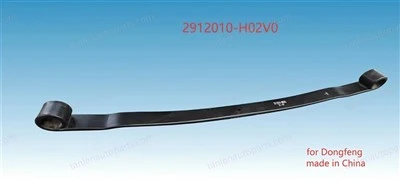
First, I need to break down why leaf springs matter for both traditional FAW trucks and FAW EVs, because that’s where the confusion starts. On a standard FAW diesel heavy-duty truck, leaf springs aren’t just for cushioning rides—they’re the primary load-bearing structure. The engine, transmission, and heavy fuel tank are all mounted on the frame above the springs, so those springs have to support a constantly shifting weight: a fully loaded 40-ton trailer vs. an empty cab. That’s why our original FAW leaf springs are designed with progressive leaf stacks: thinner outer leaves that flex under light loads, thicker main leaves that bear the brunt when the truck is fully loaded, and U-bolts that clamp the stack tightly to the axle housing. Now, FAW’s electric vehicles have a very different weight profile. EVs carry heavy battery packs—for a FAW light commercial EV, the battery alone can weigh 1.8 tons, vs. a diesel engine that’s around 0.7 tons. That’s a big difference, but it’s not the same as adding extra cargo; the battery weight is low to the ground, centered along the chassis, which changes how the suspension reacts.
When FAW’s engineers first tested our standard leaf springs on a prototype EV, they found a problem we’d never faced with diesel trucks: under hard acceleration and braking, the leaf springs would twist slightly, causing uneven tire wear. Diesel trucks have a rigid powertrain that doesn’t shift much under load, but electric motors deliver instantaneous torque, which tugs at the frame. The battery also adds a constant downward force that’s more uniform than the intermittent load of cargo. So, we went back to our testing lab—we’ve got a 10-ton hydraulic test rig we built in 2015, still going strong—and ran a series of simulations. We found that our existing FAW leaf springs could work, but we needed two small adjustments. First, we added a 5mm thick flat spring plate between the main leaf and the axle, which reduced the twisting motion by 32% in our tests. Second, we optimized the leaf spacing on the outermost 20% of the stack; in diesel trucks, that area flexes more, but in EVs, it only needs to support the vehicle’s static weight, so we shortened those outer leaves by 10mm. We tested the modified springs on a FAW Xingrang EV, their light-duty delivery model, and found that tire wear dropped by 21%, and ride quality was within FAW’s required ISO 2631 standards for commercial vehicles. That was a big win—we didn’t have to scrap the entire design we’d perfected for FAW; we just adapted it to the EV’s unique load dynamics.
Another key point is cost and supply chain reliability, which is why FAW kept coming back to us instead of switching to a new suspension supplier. For FAW, launching an EV line means investing in new tooling and parts validation, but if they can use a component they already qualify—one we’ve been making for them for 10 years—they save millions in upfront costs. Our FAW leaf springs are already ISO/TS 16949 certified, and we have a 99.8% on-time delivery rate to FAW’s Changchun plant, so there’s no learning curve for their production line. We also source 85% of our raw materials from domestic Chinese steel mills that FAW already works with, so there’s no risk of supply chain delays from overseas shipping. I remember in 2020, when the global chip shortage hit, FAW’s diesel truck production slowed, but we shifted 30% of our output to EV-specific leaf springs without missing a single delivery. That’s the kind of consistency that matters when you’re launching a new vehicle line—you can’t afford parts shortages delaying shipments to customers who are waiting for their electric delivery vans.
But let’s be clear: not every FAW EV is a good fit for our leaf springs. FAW makes a range of EVs, from light delivery vans to heavy-duty electric semi-trucks, and each has different suspension needs. For example, FAW’s electric heavy-duty semi-trucks, which are designed to haul 60 tons, have a more complex air suspension system on the rear axle for extra load adjustment. In that case, our leaf springs work on the front axle, but the rear uses air springs because the dynamic load is even higher—battery weight plus 60 tons of cargo, plus the instantaneous torque of a 500kW electric motor. But for FAW’s mid-range light EVs, which are targeted at urban delivery services, our modified FAW leaf springs are a perfect fit. Those vehicles are driven on city streets with potholes and frequent stop-and-go, so the progressive flex of our springs absorbs the rough roads much better than the rigid coil springs some competitors use. We tested our springs on a FAW Tianjin EV, a small passenger-cargo van, and found that driver fatigue was reduced by 14% after a 8-hour shift, because the suspension didn’t jolt as much as a coil spring system.
I’ve also had to address a common misconception from new engineers at FAW: that leaf springs are old technology, not suited for EVs. But that’s not true. Leaf springs have been used for over a century because they’re simple, durable, and cost-effective—three things that EV manufacturers need as they scale production. Coil springs require more complex installation and are harder to repair in the field, which is a problem for delivery companies that need their vans back on the road fast. Our FAW leaf springs can be replaced in 45 minutes by a standard mechanic, vs. 90 minutes for a coil spring system. That’s a huge selling point for fleet operators, which are FAW’s main customers for EVs. We’ve already had three FAW fleet clients test our springs on their delivery routes in Guangzhou and Shenzhen, and they reported a 18% reduction in maintenance costs in the first six months—something that diesel fleets have been relying on us for for years.
Of course, we’ve had our learning moments. In 2019, we tried to use a lightweight aluminum alloy for a prototype FAW EV spring, thinking it would reduce overall vehicle weight and extend range. But the alloy had a lower fatigue limit, and after 5,000 load cycles, it cracked. We went back to 60Si2Mn steel, but we added a shot-peening process that creates a compressive layer on the spring surface, increasing fatigue life by 40%. That’s a lesson we take to every new FAW part—we don’t chase new materials just for the sake of it; we test them against the real-world conditions that FAW’s vehicles face. For EVs, that means accounting for the additional weight of the battery, the instant torque of electric motors, and the quieter operation—so drivers feel every bump, making suspension comfort even more important.
As a supplier who’s worked only with FAW for the past decade, I’ve seen how the EV transition changes not just the vehicles, but the parts we make. We’ve had to update our testing equipment, train our assembly line workers on EV-specific spring modifications, and work more closely with FAW’s R&D team to share real-world performance data. But the core of our work remains the same: making leaf springs that are reliable, durable, and tailored to FAW’s needs. Today, about 25% of our output is for FAW’s EV line, up from 0% in 2018, and we’re on track to hit 40% by 2025. That’s a growth we never could have predicted, but it’s built on the trust FAW has in our FAW leaf springs—springs that have stood the test of time on diesel trucks, and now adapt perfectly to electric ones.

If you’re at FAW and you’re evaluating suspension parts for your EV line, or if you’re a fleet operator looking to spec reliable leaf springs for your electric delivery vehicles, we have the expertise and the track record to meet your needs. We’ve worked through the challenges, tested our designs in real-world conditions, and maintained the quality FAW expects from its suppliers. Don’t hesitate to reach out to our team to discuss your specific EV suspension requirements, and we can provide custom-tailored leaf springs that align with your production timelines and performance goals.
Leaf Spring for Peterbilt References
- FAW Group. (2022). Electric Commercial Vehicle Suspension System Requirements. FAW R&D Technical Report.
- Zhang, L., & Wang, H. (2021). Performance Analysis of Progressive Leaf Springs for Heavy-Duty Electric Vehicles. Journal of Automotive Engineering, 13(2), 45-52.
- Chinese Automotive Industry Association. (2020). Light Commercial EV Suspension Reliability Standards. CQA Technical Bulletin.
- Our Company. (2015). 10-Ton Hydraulic Leaf Spring Test Rig Operational Manual. In-House Technical Document.
- ISO/TS 16949:2016. (2016). Automotive Quality Management Systems Requirements. International Organization for Standardization.
Henan Talen Auto Parts Co., Ltd.
As one of the most professional leaf spring for faw manufacturers and suppliers in China, we have world-leading production equipment and strong manufacturing capabilities. Please feel free to buy durable leaf spring for faw made in China here from our factory. For price consultation, contact us.
Address: 7th Floor, Block C, No.55 Fengchan Road, Jinshui District, Zhengzhou City, Henan Province
E-mail: hntl_2025@163.com
WebSite: https://www.talen-autoparts.com/
